ARLand – Augmented Reality in Landscape Design
PROJECT TYPE | Research Project
TIMELINE | January – June 2023
ROLE | UX/UI Designer and Researcher, and Landscape Designer
TEAM | Pezhman Raeisian Parvari; Jolanda Tromp (My supervisor)
TOOLS | Unity; ARKit; Adobe Aero, Adobe Dimension
OVERVIEW
In this research project, the goal was to integrate augmented reality (AR) in landscape design to examine its impact on user experience and design perception. The focus was on creating an interactive AR prototype for a designated section of a university campus, allowing users to engage with and visualize the evolving landscape design. By leveraging AR technology, the project aimed to enhance the traditional landscape design process, offering a dynamic and immersive experience for users.
PROBLEM STATEMENT
This project addresses the limitations of traditional landscape design methods, which often fail to fully engage users and effectively convey the evolving nature of the design process. Recognizing the need for more interactive and immersive tools, we explored the potential of augmented reality (AR) to enhance landscape design and user experience.
By leveraging AR technology, our design aims to bridge the gap between static plans and dynamic user interaction, offering a more engaging platform for users to visualize and interact with the landscape design. We began by researching how users interact with AR in various settings, focusing on the integration of AR in landscape architecture. Our main goal was to create an interactive AR prototype that allows users to engage with the evolving landscape design of a university campus, thereby enhancing their understanding and perception of the space.
RESEARCH
USER GROUP | University staff, students, and landscape designers
In this research, we focused on university staff, students, and landscape designers as our primary user groups. By engaging these diverse users, we aimed to gather comprehensive insights into how AR technology impacts their interaction with and perception of landscape design. This approach allowed us to explore the effectiveness of AR in enhancing the user experience and its practical application within both academic and professional environments.
INTRODUCTION
ARLand is a research project focused on the integration of augmented reality (AR) in landscape planning within a designated section of a university campus. This project aims to investigate the impact of AR on user experience and how it influences the perception and interaction with evolving landscape designs. Utilizing a mixed-methods approach, the study explores the potential advantages of AR technology without incorporating artificial intelligence (AI).
BACKGROUND
ARLand delves into current landscape design practices, emphasizing the influence of technology on the design process. Traditional landscape design methods often fall short in engaging users and effectively conveying dynamic changes in design. This project addresses these limitations by incorporating AR, which offers a more immersive and interactive experience. With a background in landscape architecture and a specific focus on AR, the authors provide unique insights into how AR can revolutionize the landscape design process, enhancing user interaction and understanding of design elements.
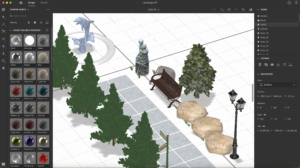
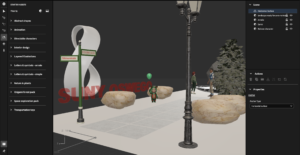
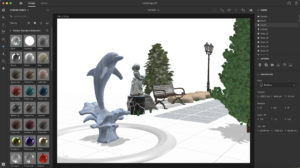
Adobe Dimension design area
METHODOLOGY
ARLand unfolds in two phases:
Phase 1: Development and Interaction
AR Prototype Development:
The first phase involves creating the ARLand AR prototype, which allows users to engage with and visualize the evolving landscape design in real time. The ARLand prototype was developed using Unity, ARKit, Adobe Aero, and Adobe Dimension to ensure a robust and interactive user experience.
Qualitative Research:
Qualitative methods, including interviews and observations, were employed to understand user interactions with the AR prototype. Landscape designers, university staff, and students were invited to interact with the prototype, providing valuable insights into their experiences and perceptions. This phase aimed to capture the nuances of user engagement and identify areas for improvement in the design.
Phase 2: Evaluation and Analysis
Quantitative Study:
The second phase involved a quantitative study through surveys distributed to university staff, students, and landscape designers who had interacted with the ARLand prototype. The surveys focused on user experience, the effectiveness of AR technologies in comprehending the design, and the influence of these technologies on the perception of space.
Data Analysis:
The collected data from both qualitative and quantitative methods were analyzed to evaluate the impact of AR on landscape design. This analysis aimed to identify key trends, user preferences, and areas where AR significantly enhanced the design and user experience.
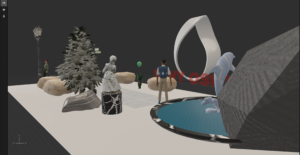
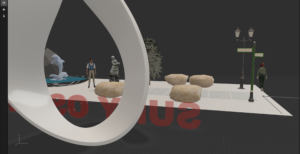
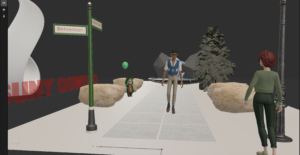
ARLand 3D Model in Different Views
USABILITY TESTING
Objective:
The usability testing aimed to evaluate the effectiveness, efficiency, and user satisfaction of the ARLand AR prototype in enhancing the landscape design experience for users.
Participants:
Number of Participants: 6
Demographics:
Participants included a mix of students, professionals, and academics from fields related to architecture, landscape design, and urban planning. The participants were aged 20 to 60 years, with 60% male and 40% female.
Experience Levels:
Participants varied in their familiarity with technology and AR, ensuring a diverse range of insights.
Procedure:
Introduction and Briefing:
Participants were briefed about the purpose of the study and the functionalities of the ARLand AR prototype.
They were informed about the tasks they would perform and were assured that their participation was voluntary, with the option to withdraw at any time.
Task Performance:
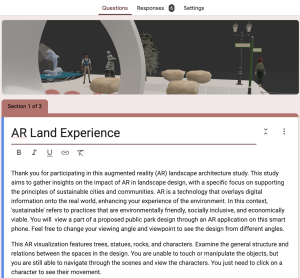
Participants were given a smartphone or tablet with the ARLand application installed.
They were asked to explore a proposed public park design through the AR application, interacting with various design elements such as trees, statues, rocks, and characters by changing their viewing angles and perspectives.
Participants spent approximately 10 minutes engaging with the AR prototype, during which they could freely navigate and interact with the design elements.
Feedback Collection:
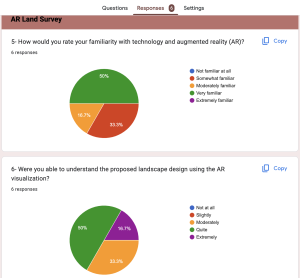
After interacting with the AR prototype, participants completed a questionnaire designed to capture their feedback on various aspects of the user experience.
The questionnaire included questions on their understanding of the design, engagement level, perceived effectiveness of AR in conveying design elements, and overall satisfaction with the AR experience.
In-Depth Interviews:
Following the questionnaire, in-depth interviews were conducted with a subset of participants. These semi-structured interviews allowed for a deeper exploration of their experiences, perceptions, and any challenges encountered while using the AR prototype.
Data Analysis:
Descriptive Statistics:
Summarized the demographic information and responses from the questionnaire to identify common themes and trends.
Qualitative Analysis:
Thematic analysis of interview transcripts to extract detailed insights and user feedback.
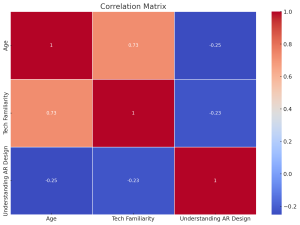
Correlation Analysis:
Examined relationships between variables such as age, tech familiarity, and understanding of AR design.
Advanced Visualizations:
Created visual representations, such as box plots and scatter plots, to highlight key findings and correlations.
Regression Analysis:
Assessed the impact of age and tech familiarity on the understanding of AR design.
CONCLUSION
The integration of Augmented Reality (AR) in landscape design presents a promising avenue for enhancing user experience and promoting sustainable urban development. This study evaluated current AR applications, assessed their impact on user experiences, and explored their role in communicating sustainability practices within urban environments.
Key Findings:
Effectiveness of AR in Enhancing Understanding and Engagement:
The study found that AR significantly improves users’ comprehension of landscape designs and increases engagement compared to traditional methods. This supports the hypothesis that AR applications are effective in enhancing user understanding and engagement.
Impact of AR on User Experiences:
The findings indicate that AR provides a more immersive and interactive experience for users, positively affecting their perceptions of sustainable landscape designs. This aligns with the hypothesis that AR significantly impacts user experiences in sustainable urban landscapes.
Role of AR in Communicating and Promoting Sustainability:
AR was shown to be an effective tool for conveying information about sustainable practices. Participants appreciated the ability to visualize sustainable elements within the landscape design, which promotes environmental awareness and encourages sustainable behavior. This confirms the hypothesis that AR is an effective tool for promoting sustainability practices.
Practical Implications:
For urban planners and landscape designers, the integration of AR can provide several practical benefits:
Enhanced Visualization:
AR allows for more detailed and interactive visualization of landscape designs, aiding in better decision-making and planning.
Increased Public Engagement:
By making designs more accessible and understandable, AR can engage the public more effectively, fostering a sense of involvement and support for urban projects.
Promotion of Sustainable Practices:
AR can highlight sustainable features in a way that is easily comprehensible, promoting environmental awareness and responsibility.
Limitations and Future Research:
While the study provides valuable insights, there are some limitations to consider:
Sample Size:
The relatively small sample size of six participants may limit the generalizability of the findings. Future research should include a larger and more diverse participant pool.
Technological Barriers:
Some users may face technological barriers, such as limited access to AR-enabled devices or lack of familiarity with the technology.
Long-term Impact:
This study focused on immediate user reactions. Future studies should investigate the long-term impact of AR on user behavior and attitudes towards sustainability.
Further research should explore additional variables that might influence the effectiveness of AR in landscape design, such as prior experience with AR, specific design features, and the context in which AR is used. Additionally, longitudinal studies could provide deeper insights into the lasting effects of AR on user engagement and sustainability practices.
THINGS I LEARNED
- Understanding the impact of AR on user engagement was deepened through comprehensive research and usability testing. Engaging with various user groups, including landscape designers, university staff, and students, provided invaluable insights into how different users interact with AR technology in the context of landscape design.
- The development of interactive and immersive experiences using AR technologies was a key focus. I discovered how AR can be harnessed to create dynamic and engaging landscape visualizations, significantly enhancing user understanding and involvement in the design process.
- Conducting usability testing with diverse participants presented challenges, particularly in ensuring the technology was accessible and intuitive for all users. To address these challenges, we adapted our testing methodologies to include clear instructions and support, allowing participants to comfortably navigate and interact with the AR prototype.
- The importance of user-centered design was highlighted throughout the project. I developed detailed user personas to tailor the design to the specific needs and preferences of the target audience. Through iterative usability testing and feedback collection, we refined the ARLand prototype to ensure it effectively met the users’ expectations and provided a satisfying user experience.