Designing for Individuals with ADHD – An AR Public Speaking Game
PROJECT TYPE | A Project State University of New York at Oswego
TIMELINE | April 2023
ROLE | UX Researcher/Designer
TEAM | Pezhman Raeisian Parvari
TOOLS | Figma; Unity; ARKit
OVERVIEW
In this academic project, the goal was to design an augmented reality (AR) game to assist individuals with ADHD in overcoming anxiety related to public speaking. The focus was on creating a simulated public speaking environment using AR technology, enabling users to practice and improve their public speaking skills in a realistic, immersive setting. The game aimed to reduce stress, enhance skills, and provide a therapeutic tool specifically tailored for individuals with ADHD.
EVENT PARTICIPATION
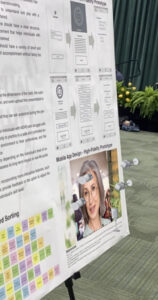
Attending Quest 2023 at the State University of Oswego in New York with a poster presentation.
QUEST 2023 POSTER
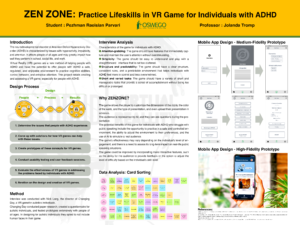
PROBLEM STATEMENT
This project addresses the significant stress experienced by individuals with ADHD, particularly in the context of public speaking. Recognizing the high levels of anxiety and the challenges associated with traditional public speaking training for individuals with ADHD, we conceptualized an augmented reality (AR) game to create a supportive and immersive practice environment.
By integrating AR technology, our design not only aims to alleviate public speaking anxiety but also offers an engaging platform for skill enhancement. We began by researching the common challenges faced by individuals with ADHD in both academic and professional settings, focusing on their interaction with digital technologies and games. Our primary goal was to develop an AR game that provides realistic public speaking scenarios, enabling users to practice in a gamified, low-stress environment. This approach aims to reduce anxiety, improve public speaking skills, and offer a therapeutic tool for individuals with ADHD.
RESEARCH
USER GROUP | Individuals with ADHD
We conducted extensive research on individuals with ADHD to understand the common challenges they face, especially in public speaking contexts. Our research focused on exploring modern technologies such as augmented reality (AR) and virtual reality (VR) in game design. We investigated key concepts including AR, digital technologies, and game design principles to inform the development of our game. This research provided valuable insights into the needs and preferences of our target user group, guiding the design of an effective and engaging AR game aimed at reducing public speaking anxiety.
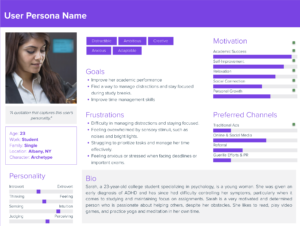
PERSONA
In our design process, we took deliberate steps to ensure our game resonated with individuals with ADHD. Crafting two fictional user personas allowed us to embody the characteristics of the users expected to benefit from the game, enabling a tailored design that aligns with their needs and preferences. This meticulous approach extended to the user journey, where we carefully planned the steps users would take to seamlessly navigate and utilize the game. Our design journey commenced with extensive brainstorming and research, culminating in the creation of these user personas.
Additionally, secondary research informed us about key principles in augmented reality, emphasizing user comfort, intuitive navigation, immersive environments, responsive feedback, and realistic interactions. This informed approach ensured our design addressed the unique challenges faced by individuals with ADHD, providing an engaging and supportive platform for practicing public speaking.
CONCEPT GENERATION & WIREFRAMING
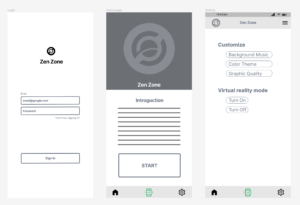
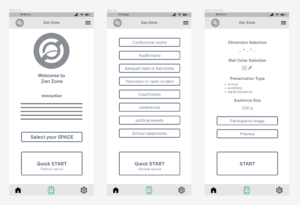
Ideation was instrumental in guiding us through the development process, leading to the creation of low-fidelity mockups and wireframes in Figma. Progressing to the high-fidelity phase, we fashioned a prototype based on our vision in Figma, complemented by the use of Unity and ARKit to develop immersive AR environments for users on their journey.
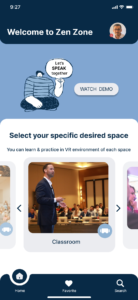
The ZenZone App prioritizes simplicity and accessibility for individuals with ADHD, incorporating cutting-edge augmented reality technology. We also considered the crucial involvement of therapists and support groups to enrich the overall user experience and provide a comprehensive tool for stress reduction and skill enhancement in public speaking.
USABILITY TESTING
Usability testing played a critical role in refining the ZenZone App. We conducted several rounds of testing to gather feedback from individuals with ADHD, focusing on the app’s usability, effectiveness, and overall user experience.
Method:
We employed a mix of moderated and unmoderated usability testing sessions. Participants were asked to perform specific tasks within the app, such as navigating through different public speaking scenarios, interacting with virtual audiences, and using various features designed to reduce anxiety.
Feedback Collection:
Participants provided verbal feedback during the sessions, and their interactions were recorded for further analysis. Additionally, post-test surveys were distributed to collect more structured feedback on their experience.
Results:
The feedback highlighted areas for improvement, including the need for more intuitive navigation, clearer instructions, and additional customization options to better cater to individual preferences and needs.
Redesign:
Based on the feedback, we iteratively redesigned the app, making necessary adjustments to enhance user comfort and effectiveness. This included refining the user interface, improving the responsiveness of virtual interactions, and ensuring the AR environments were more immersive and supportive.
DESIGN
In conclusion, our project successfully met its objective of developing the ZenZone App—an augmented reality game designed to support individuals with ADHD in overcoming public speaking anxiety. This app not only engages users through immersive and interactive AR environments but also provides a therapeutic platform tailored to their unique needs.
By integrating user feedback and incorporating key design principles, we created a user-friendly and effective tool that helps users practice public speaking in a safe, gamified setting. The ZenZone App fosters skill enhancement, reduces stress, and offers a valuable resource for individuals with ADHD, ultimately contributing to their overall well-being and confidence in public speaking scenarios.
Sketch:
In the design thinking process of this project, sketching graphically represented the development of ideas and the visual representation of the product’s flow and functioning. These initial sketches helped conceptualize the layout and functionality of the ZenZone App, providing a foundation for further development.
Low-Fi Prototype:
The very first prototype was designed in this section, focusing on the basic structure and user interactions within the app.
MEDIUM-FI Prototype:
In this step, we conducted usability testing, utilized evaluation methods, gathered end-user feedback, and implemented redesigns based on the feedback received. This iterative process ensured the app’s design was user-centric and addressed the specific needs of individuals with ADHD.
HIGH-FI Prototype:
After collecting all of the primary and secondary research, it was time to organize the findings. The designer improved the prototypes and finalized a high-fidelity prototype design in this part. This high-fidelity prototype incorporated detailed user interactions and realistic AR environments, ensuring the app was both functional and engaging for users.
INTERVIEW
The interview was conducted with Nick Lang, the creative director of Changing Day, a company that makes games for people with autism and other neurodiverse conditions. Their game was created using input from autistic people and a great deal of research, which was published in January. The interviewee stressed the significance of designing games with the user in mind and steering clear of presumptions. They also talked about the difficulties in making multiplayer video games and how VR technology might benefit people with a range of issues, including loneliness and autism. The interviewee indicated a desire to grow their business to include games for other neurodiverse user bases and a dedication to creating a new game featuring the same characters but with new technology. In summary, the interview yielded valuable perspectives on the significance of user-centered design and the potential of virtual reality technology to assist people with diverse medical conditions.
WHO AND WHERE CAN THIS APP BE USED
The ZenZone App is designed for individuals with ADHD, providing a comprehensive tool to assist in managing various aspects of their condition. Here’s how and where it can be used:
Who Can Use the App:
Individuals with ADHD: The primary users are people diagnosed with ADHD who seek to improve their public speaking skills and manage related anxiety.
Students: Students with ADHD who face challenges in classroom presentations and other speaking engagements.
Professionals: Employees with ADHD who need to enhance their public speaking abilities for meetings, presentations, and professional interactions.
Therapists and Counselors: Professionals working with ADHD individuals can use the app as a supplementary tool in therapy sessions.
Where the App Can Be Used:
Educational Institutions: Schools and universities can incorporate the app into their curriculum to support students with ADHD in developing their public speaking skills.
Workplaces: Companies can offer the app as part of their employee wellness programs to help employees with ADHD manage anxiety related to public speaking.
Therapy Sessions: Therapists can integrate the app into cognitive-behavioral therapy sessions, using it as a practical tool to teach and practice coping strategies.
Home: Individuals can use the app in the comfort of their homes, providing a private and convenient way to practice public speaking and manage ADHD symptoms.
Key Strategies Provided by the App:
Enhancing Executive Functioning: The app includes exercises and scenarios to help users improve their planning, organization, and focus skills.
Controlling Hyperactivity and Impulsivity: Interactive features designed to help users develop strategies for managing hyperactivity and impulsivity.
Enhancing Working Memory: Tasks and activities aimed at improving working memory capabilities.
Cognitive-Behavioral Methods: Incorporation of techniques for teaching and practicing cognitive-behavioral methods for symptom management.
Sensory Regulation: Tools and activities to help users enhance their regulation and integration of senses.
Rewarding Activities: The app provides a gamified and engaging platform, ensuring users participate in a rewarding and pleasurable activity.
THINGS I LEARNED
The importance of understanding user engagement was highlighted through extensive research on how individuals with ADHD interact with technology, particularly in stress-inducing scenarios like public speaking. This research was crucial in designing an application that is both engaging and user-friendly for this specific audience.
Creating immersive experiences using augmented reality (AR) technology was a significant focus. I discovered how AR could be harnessed to develop interactive and therapeutic environments that help individuals with ADHD practice public speaking in a realistic, yet low-stress setting.
The value of user-centered design was reinforced through iterative usability testing and feedback. I learned that continuous improvement based on real user input is vital to creating a successful and effective application.
The therapeutic potential of gamified learning environments became evident. By incorporating game elements, I realized how we could make the process of skill development enjoyable and less intimidating for individuals with ADHD.
The importance of collaboration with professionals and stakeholders, such as therapists and educators, was underscored. Their insights were invaluable in ensuring that the app not only met user needs but also adhered to best practices in therapeutic and educational contexts.
Augmented Reality in the poster:

REFERENCES
- “Introduction to Virtual Reality,” XR Association. Available at: https://xra.org/
- “Augmented Reality in Game Design,” Augmented Reality Trends. Available at: https://www.augmentedrealitytrends.com/
- “Living with ADHD,” ADHD Institute. Available at: https://adhd-institute.com/
- “Understanding ADHD,” American Psychiatric Association. Available at: https://www.psychiatry.org/patients-families/adhd
- “Public Speaking Anxiety in Individuals with ADHD,” Journal of Attention Disorders. Available at: https://journals.sagepub.com/home/jad
- “Principles of Game Design,” Game Design Foundation. Available at: https://www.gamedesignfoundation.org/
- “User-Centered Design in Game Development,” UX Collective. Available at: https://uxdesign.cc/
- “The Role of Games in ADHD Therapy,” ADHD Therapeutics Journal. Available at: https://www.adhdtherapeuticsjournal.com/
- “Gamification in Therapy,” Psychology Today. Available at: https://www.psychologytoday.com/us/blog/gamify
- “Usability Testing for Digital Health Applications,” HealthIT.gov. Available at: https://www.healthit.gov/
- “Gathering and Implementing User Feedback,” Nielsen Norman Group. Available at: https://www.nngroup.com/